Mercari, a C2C marketplace with 24 million monthly active users, first used Photoroom’s background blur to help casual sellers list from cluttered homes. It then tested Photoroom’s Visual Agents in a four-week test, using Visual QA to check listing photos and Create & Transform to fix lighting and shadows only where needed. Over 80% of sellers who tried the improved photos kept them over their originals.
Life before Photoroom
Sellers listed less to avoid showing cluttered homes
White backgrounds made casual sellers feel out of place
Earlier AI tools gave poor-quality product photos
Poor lighting and hand shadows in seller photos
No way to spot which photos actually needed fixing
Editing every photo would add unnecessary cost and wait times
Life with Photoroom
One-tap background blur helped casual sellers list more
Visual QA screened over 2 million listing photos so AI edit costs only went where needed
About 300,000 unique sellers were offered a suggestion
20%+ of sellers tried the improvement after seeing it
Over 80% of sellers who tried the AI-improved photos kept them over their original images
"Photoroom stands out for its quality, flexibility and collaboration. We've been able to tackle background issues with their team, and now we're tackling lighting and shadows together."
— Yasuo Hishii, Director of Product Management at Mercari
Mercari is a C2C marketplace headquartered in Japan, with 24 million monthly active users. Most sellers are everyday people clearing out things they no longer need.
"Our marketplace always starts from the seller's unnecessary item," explains Yasuo Hishii, Director of Product Management at Mercari. When sellers struggle to photograph those items at home, they list less, and buyers have less to choose from, which means missed sales and revenue for Mercari.
Two of Mercari's product leaders have worked to solve that problem. Yasuo Hishii, a former engineer and the Director of Product Management at Mercari, and Nick Pittoni, AI/LLM Consumer Product Lead at Mercari, work on adopting AI to improve the customer experience. With Photoroom, their team has tackled seller photos one problem at a time.
Cluttered backgrounds and poorly lit photos across the millions of listings
Mercari's photo challenge was twofold: Cluttered, private backgrounds made some sellers list less often, and poor lighting and shadows affected photos across millions of listings, too many to fix by hand.
Sellers listed less to avoid showing cluttered homes
Mercari’s user research shows that sellers care about showing an item’s true condition accurately. "There's a high bar for sellers and buyers, and you're kind of expected to know what you're doing," explains Nick. "Otherwise you can get negative feedback fairly easily."
So, sellers document every stain and flaw on an item in visuals, down to photographing the back of a CD "at precisely the right angle to show buyers exactly how many scratches to expect," Nick shares.
That care goes beyond the item itself to whatever else shows up in the photo. In user interviews, Nick's team found that several sellers listed less often, not because of their items, but because of where they took the photos.
"Many sellers are often very conscious about where they're taking their photos. In Japan, more often than not, maybe the house is a bit small, the space is kind of cramped, and the background can be messy."
— Nick Pittoni, AI/LLM Consumer Product Lead at Mercari
Rather than show a messy room, some sellers postponed or abandoned listings, and every listing that never went live meant reduced marketplace liquidity and missed growth opportunities for Mercari.
Earlier tools hadn't helped either. The team had tried iOS SDK tools and third-party models to improve images, but "the quality wasn't very good across the board," Nick explains.
Then came the challenge of fixing lighting and shadows at scale
Backgrounds weren't the only problem. Most sellers also lack the skills and equipment to take a good photo. "The majority of our sellers are general consumers," Yasuo explains. "They don't have enough knowledge or technique to take photos, but they make up a large part of our business."
Looking closer, Yasuo's team found poor lighting, and sometimes the seller's own hand casting a shadow on the item. Sellers listed those photos anyway, and so buyers saw darker, less clear listings. "If we can remove those problems, we can expand the seller target more drastically," Yasuo shares.
Fixing lighting and shadows across Mercari's marketplace came with two constraints:
Every listing is unique: Most listings depend on the seller's own photo. "Even if ten users list the same ten items, each item becomes unique," says Yasuo.
Editing millions of seller photos wasn't practical: Without a way to spot which photos needed fixing, AI editing would apply to every photo, including good ones, adding waiting time for sellers and cost for Mercari.
The team needed a way to spot photos that required improving and fix only those.
Mercari's first solution: a one-tap background blur feature that hides cluttered homes
Mercari's team started with backgrounds. They initially tried full background removal, so sellers could place items on clean white backgrounds. However, the seller conversion rate (SCR) and sell-through rates (STR) went down, especially for light listers. Mercari's users browse as buyers before they list, and a feed of studio-style white backgrounds told casual sellers their items didn't belong on the platform.
"We thought, 'this background removal option is perfect, let's introduce it'. But then we realized that if sellers see only white background pictures, they might feel that listing their own items here is too high a hurdle."
— Yasuo Hishii, Director of Product Management at Mercari
So the team scaled the editing back. Instead of replacing the background with white, they opted for a solution that blurs the image background, which hides the clutter while the item and its surroundings still look real.
Using the Photoroom API:
3-4 engineers at Mercari built a one-tap background blur feature into the platform within 2-3 months.
When Mercari sellers open the live camera to photograph an item, they click a single button and it instantly blurs their background.
Casual sellers published more items, and pro sellers adopted it even more.
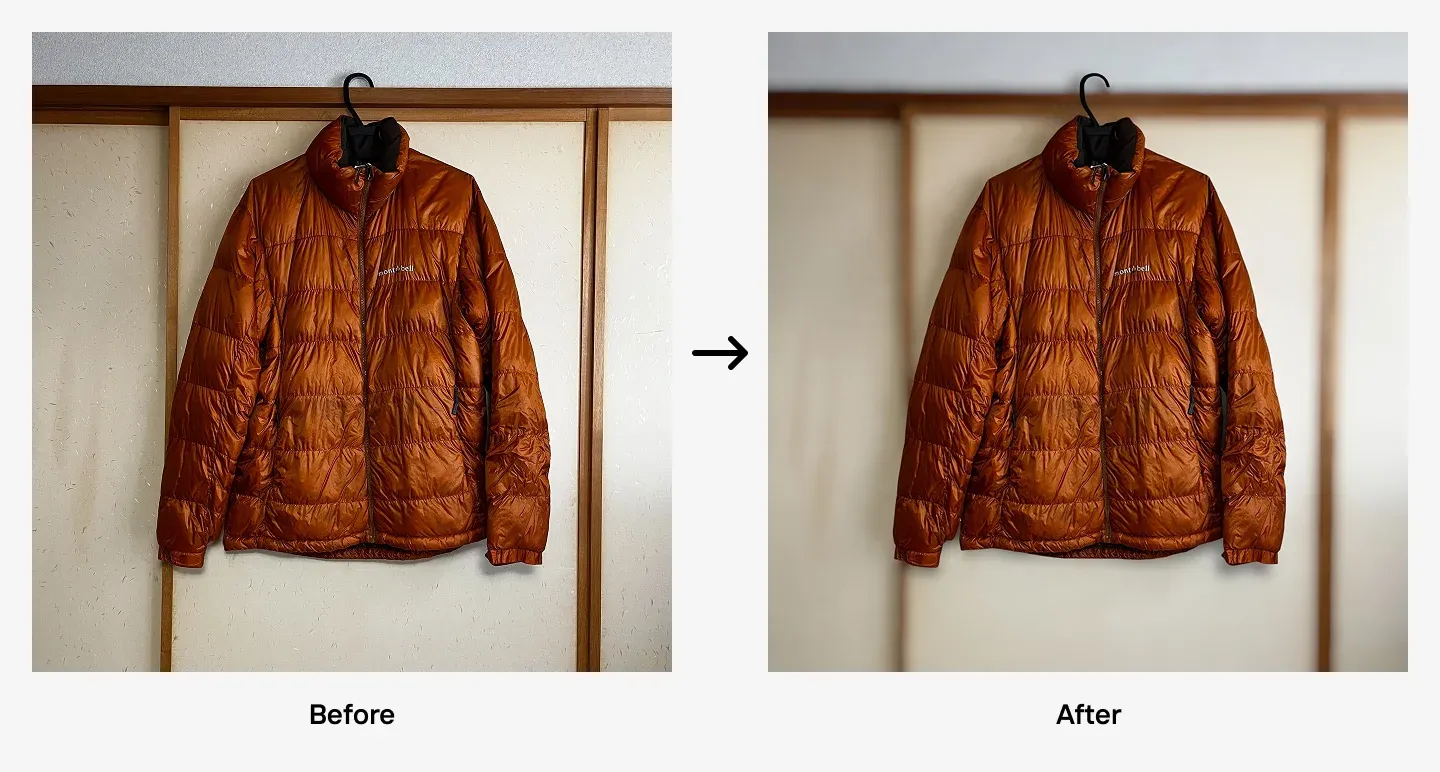
A Mercari listing photo before and after background blur. Source: Mercari
"The Photoroom API was very easy to integrate. Working with the Photoroom commercial and technical teams was smooth and straightforward. We got to production quickly with a small team, and now Photoroom processes high-single-digit millions of images monthly for our sellers without slowing the listing experience."
— Nick Pittoni, AI/LLM Consumer Product Lead at Mercari
Moving from white backgrounds to blur taught the team that, for Mercari's sellers, more editing isn't always better. What matters is providing imaging solutions that improve sellers’ confidence.
The second solution: Visual Agents to check 2M+ photos and fix only those that need it
For lighting and shadows, Yasuo’s team needed a solution that could automatically analyze seller photos at scale and fix only those that need improving. Checking each photo first and fixing only the flagged ones is what makes this workable at Mercari's volume. “By combining the two, we can work at production scale,” Yasuo explains.
The team made its decision in two steps:
First, they benchmarked lighting and shadow solutions on real listing photos and chose Photoroom for quality.
Then they ran a live test with sellers to prove the value at scale.
"In the several benchmarking results, Photoroom's solution demonstrated the best quality to meet our customers' expectations."
— Yasuo Hishii, Director of Product Management at Mercari
Testing Photoroom's Visual Agents solution with sellers in a four-week A/B test
The team needed to prove that Photoroom's Visual Agents, with a focus on Visual QA as the first step of the workflow and then Create & Transform for Relight and Shadow Removal, worked at scale.
For four weeks, Mercari offered the feature to a test group of sellers but not a control group, then compared the two groups on listings, items sold, and other metrics. And because few sellers try a new feature early on, they then measured what happens once a seller applies the fix, including sell-through rate, average number of listings per seller (ALPU), and average number of sold items per seller (ASPU).
They introduced the solution as part of the normal listing flow in every category, aimed mainly at fashion and hobby items such as trading cards, comics and figures, which account for about two-thirds of transactions on Mercari.
Here’s how the process worked during the four-week test:
Visual QA analyzes the photo: When a seller took a photo, Visual QA checked it in the background for lighting or shadow problems, against standards Mercari defined. Photos that already looked good went through to listing.
The seller sees a suggestion: If Visual QA flagged the photo, a dialog appeared and suggested that the seller try improving it.
Relight and Shadow Removal fix the photo: If the seller chose to try the improvement, Create & Transform fixed the photo with Relight (which corrects the lighting) and Shadow Removal (which removes shadows such as the seller's own hand).
The improved photo goes live: The solution applied the improved photo first, and the seller could tap to switch back to the original if they wanted.
The entire flow sat inside the normal listing process, so sellers didn’t have to do anything differently. “This additional flow basically does not harm the seller’s photo-taking experience,” Yasuo explains.
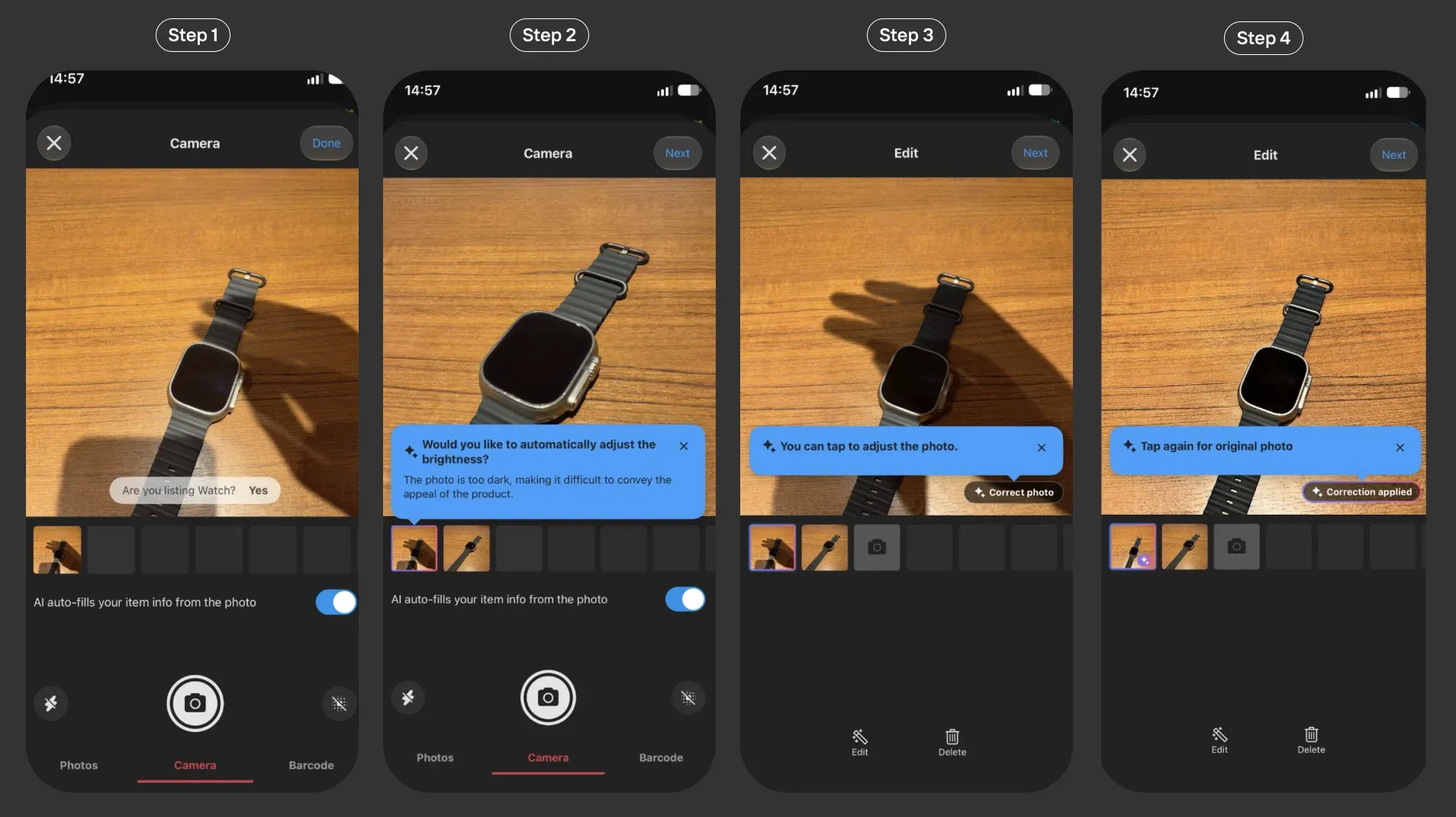
User workflow on the Mercari platform showing Photoroom’s solution at work during the test. Source: Mercari
Why Mercari partners with Photoroom today
Quality won the benchmark, but for Yasuo, it's one of three reasons Mercari keeps working with Photoroom:
Quality: Photoroom's results best met what Mercari's sellers expect.
Flexibility: When Yasuo's team spots a seller issue, it can work out possible solutions with the Photoroom team.
Collaboration: Photoroom's team works closely with Mercari's product team, sometimes visiting its headquarters in Japan to see real seller issues and building prototypes together.
"From these three points, I think Photoroom is a good partner to work with," he says.
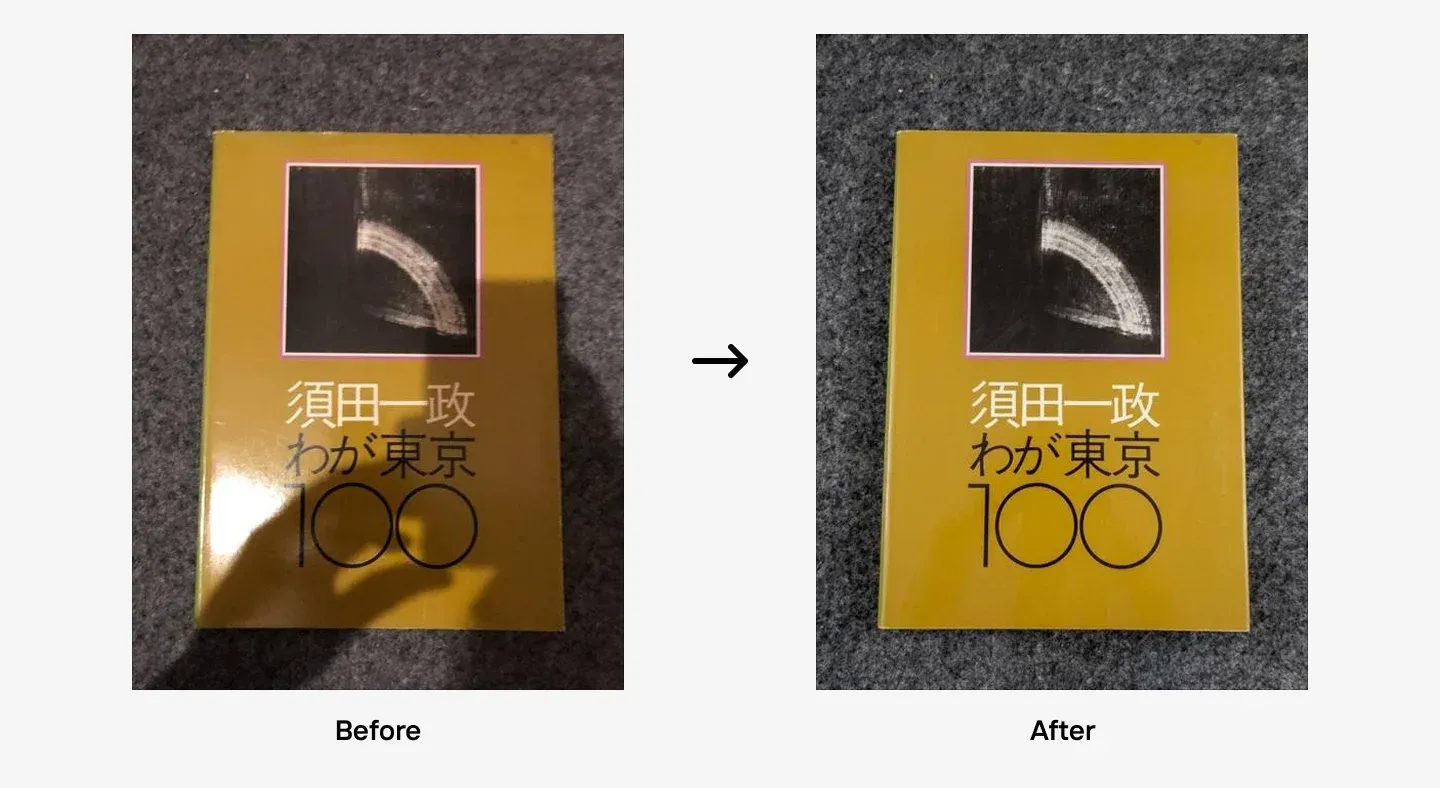
A seller photo before and after Relight and Shadow Removal. Source: Mercari
The results: over 80% of sellers who tried AI-improved photos kept them
Across both projects, here's what Mercari achieved with Photoroom:
Visual QA analyzed over 2 million listing photos at the moment of listing to identify those that could benefit from a fix.
About 300,000 unique sellers were offered a suggestion for image improvement.
More than 20% of those sellers tried the improvement after seeing the suggestion.
Over 80% of sellers who tried the AI-improved photos kept them over their original images.
Background blur also gave casual sellers the confidence to list more, and heavy sellers adopted it even more than light sellers.
"Photoroom helps sellers build confidence to showcase the products they're most passionate about. By boosting sellers' confidence when taking listing photos, anyone can list anything, anywhere, at any time."
— Nick Pittoni, AI/LLM Consumer Product Lead at Mercari
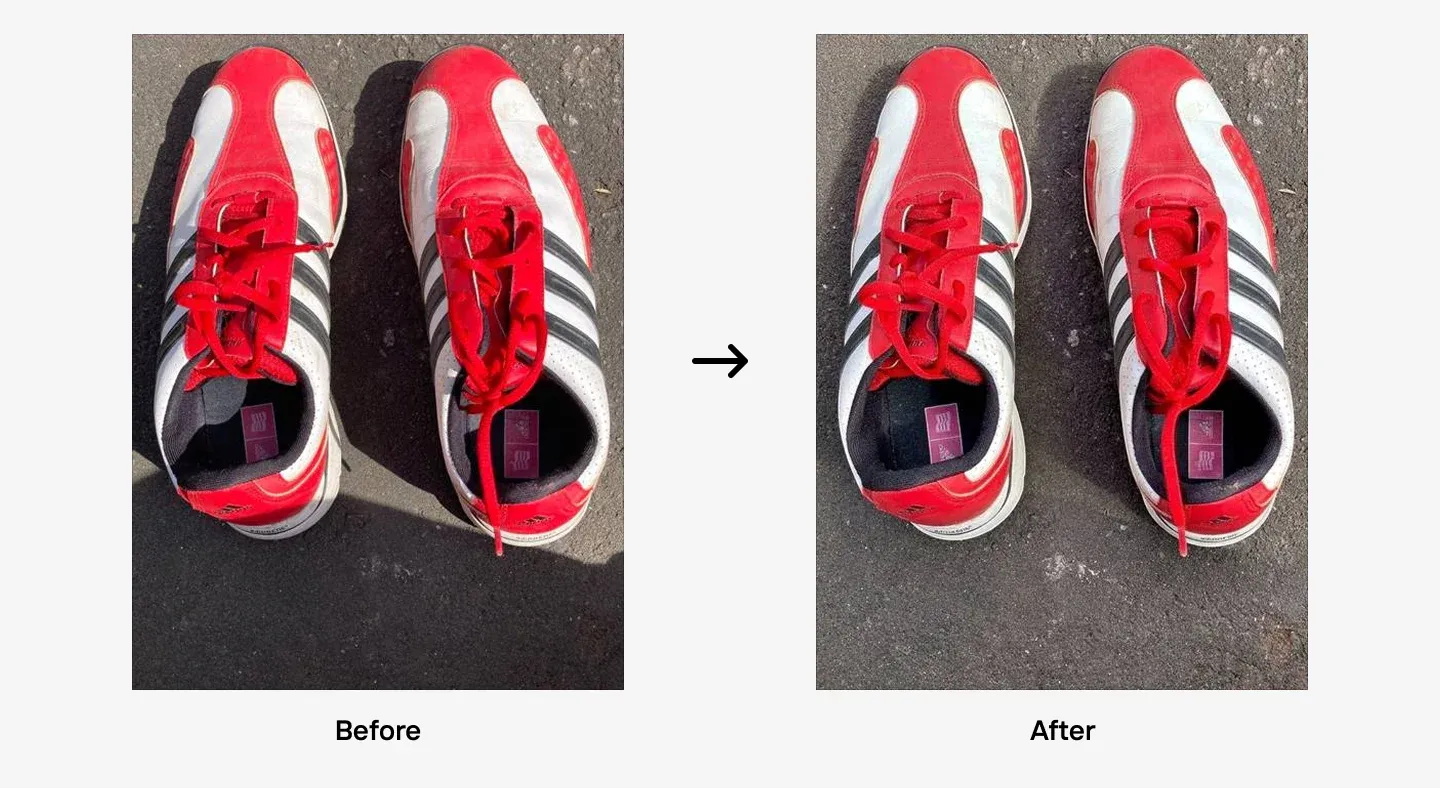
A seller photo before and after Relight and Shadow Removal. Source: Mercari
What's next: better photos after listing, and for buyers
Next, Yasuo hopes to extend photo support beyond the moment of listing. Buyer behavior on each listing can show which photos aren't working, so sellers could get a suggestion to improve a photo even after their item goes live.
"For the seller's experience, we have to take care of not only the listing phase but also the after-listing phase. We can get the marketplace buyers' behavior data for each listing. Based on it, we can make a suggestion for sellers: 'Hi, would you like to improve the photo more?' This gives confidence to the sellers."
— Yasuo Hishii, Director of Product Management at Mercari
He is also interested in ways to support sellers before they take a photo, such as showing which photos suit each kind of item. Buyers could benefit too. Fashion is one of Mercari's largest categories, and the team sees virtual try-on as a way to help shoppers picture how a shirt or jacket would look on them.
Mercari’s team looks forward to continuing to work with Photoroom to improve the seller experience, staying focused on what sellers actually need.
Photoroom is the AI image editing and visual QA platform that enables marketplaces to check every seller photo and fix only those that need it. At Mercari, over 80% of sellers who tried AI-improved photos kept them.