



Photoroom vs Nano Banana 2 comparison: a model vs a complete AI product
Photoroom and Nano Banana 2 (Gemini 3.1 Flash Image) are two recognizable names in AI-powered image production, but they're built for different image needs. Nano Banana 2 is Google's latest image generation model for general creative image tasks. Photoroom is a specialized platform that automates product photography at scale for commerce.
If you're an e‑commerce leader weighing the value of adopting a general AI model vs. a production-grade solution for AI product photography, this guide will help you make a strategic decision. We'll explain the difference between Photoroom and Nano Banana 2, how to decide between integrating Photoroom or building with Nano Banana 2, and why e‑commerce businesses choose Photoroom.
Table of contents
What’s the difference between Photoroom and Nano Banana 2?
The core difference between Photoroom and Nano Banana 2 lies in what each is built to do. Nano Banana 2 (also known as Gemini 3.1 Flash Image) is a general-purpose AI model for image generation. Photoroom is a production-ready platform for e‑commerce AI product photography that handles SKU consistency, quality assurance, and marketplace compliance at scale while preserving product accuracy.
Nano Banana 2 generates and edits images using natural language prompts, with faster generation speed than its predecessor (Nano Banana Pro), resolution up to 4K, and what Google calls "advanced world knowledge" pulled from real-time web data.
Real-time web knowledge supports creative accuracy for tasks like storyboarding and developing product mockups, but e‑commerce requires fidelity to the actual product, not web-sourced interpretations of it. The model can't guarantee predictable results across thousands of SKUs, can't enforce brand guidelines automatically, and isn't optimized to preserve product accuracy at scale. General AI models often hallucinate image details, altering products in ways that mislead buyers and damage brand trust, which directly affects sales.
Photoroom is a complete solution built specifically for commercial photography. The platform's proprietary AI models, such as the industry-leading background removal model, are trained on e‑commerce images. It combines its own models with specialized external models (including Google's Nano Banana for specific use cases), then integrates them into an end-to-end system with specialized image features for product photography automation, brand governance, and consistent, high-quality outputs. Photoroom delivers accurate, realistic product images — including production-ready exports up to 4K — without the hallucination and distortion common in general AI models.
Here's how Photoroom and Nano Banana 2 compare at a glance:
| Feature | Photoroom | Nano Banana 2 |
|---|---|---|
| Model specialization | Multiple proprietary and external models trained on 1B+ e‑commerce and marketplace images | Single general-purpose model built on real-time information and images from Google Search |
| Primary focus | Professional AI product photo editing for large catalogs | General-purpose image generation and editing for creative use cases |
| Key features | API automation, batch editing, branded templates, automated formatting for marketplaces, automated quality assurance, background removal, virtual models, product staging, image generation from text, image editing via natural language | Image generation from text, image editing via natural language, character consistency, batch image generation, text rendering and translation, real-time web knowledge grounding |
| Speed & scalability | Fast processing speed; processes millions of images monthly with 99.9% uptime | Fast processing speed; scalability depends on API tier and infrastructure setup |
| Output consistency | Consistent, production-grade outputs across catalogs | Maintains character consistency for up to five characters, relevant for storyboards and product mockups |
| Product accuracy | Preserves product details without hallucination or alteration | Preserves image fidelity best for creative use cases like character development |
| Security | SOC 2 Type II certified for API security | SOC 2 and other Google Cloud certifications |
| Availability | Web, mobile apps (iOS and Android), API access, custom API integration | Gemini app, AI Studio, Gemini API, Vertex AI, integrated into Google Search and Ads |
| Cost structure | Tailored pricing that scales with business | Token-based pricing plus development and integration costs |
| Best for | E‑commerce brands that need production-ready infrastructure for consistent, accurate product photos at scale | Developers and creative teams building custom AI image generation applications |
Nano Banana 2 delivers general-purpose image generation with improved quality, but stronger general image quality doesn't solve e-commerce-specific image production problems. Photoroom is an all-in-one AI product photography platform that automates workflows, preserves product accuracy, and guarantees consistent outputs for commerce teams at scale.
Background removal + shadow: Photoroom vs Gemini
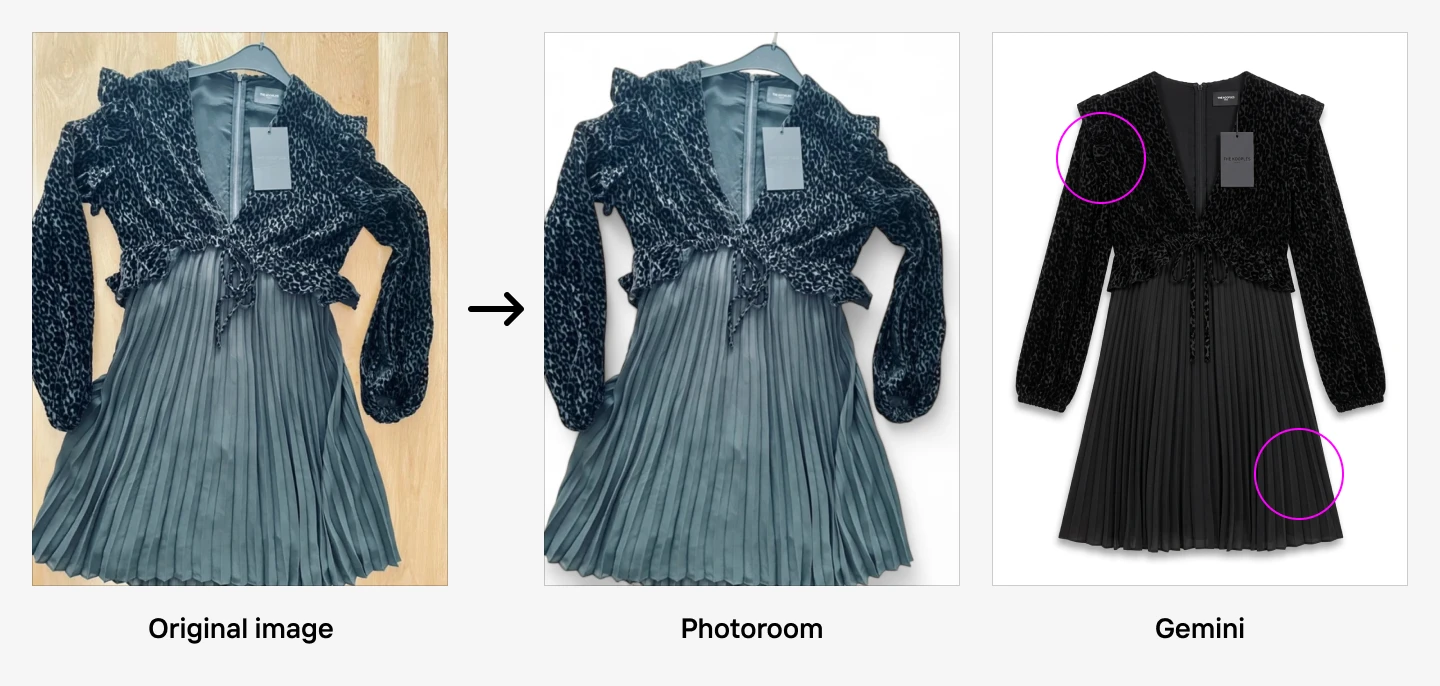
Dress image showing how Photoroom preserves product accuracy, maintaining the original fabric color, texture definition, and fine details across sequins and pleats. Gemini Nano Banana darkens the color of the dress, obscuring critical product details that buyers use to make purchasing decisions.
Prompt used for Gemini: "Remove the background and place the object on a white background. Align the object vertically at the bottom. Add 15% of padding on all sides. Add a realistic soft shadow to the object."
Photoroom API parameters used:
Output size: 2000x2000
Shadow mode: ai.soft
Vertical alignment: bottom
Padding: 15%
Background color: white
Photoroom model: pr-ai-shadows-model-version: 2025-08-14
How Photoroom integrates Nano Banana and other AI models
Photoroom integrates Google’s Nano Banana model for select image editing and generation features, but it's only one component in a larger multi-model architecture.
Photoroom uses a model-agnostic approach. The platform is built on its own proprietary models and can integrate select external models where needed, using this foundation to provide specific image editing functions such as product preservation, lighting, segmentation, retouching, scene generation, and quality analysis.
On top of this multi-model foundation, Photoroom adds API access for e‑commerce photo automation at scale, brand governance tools for image control, automated quality assurance for realistic, high-quality results, and security infrastructure for data protection.
This architecture means Photoroom continues to evolve its proprietary models and isn't locked into a single external AI model, which provides three primary long-term benefits to businesses:
The quality and consistency of output don't depend on one model's behavior.
Businesses don’t have to rebuild workflows or interfaces when better models emerge.
Teams never spend resources evaluating, maintaining, or migrating models.
With Photoroom, you're not buying access to AI models; you're getting a complete solution that consistently delivers high-quality, realistic results. Photoroom's model-agnostic platform ensures that e‑commerce businesses always benefit from the latest AI advances without managing infrastructure or model dependencies themselves.

When to choose Photoroom vs Nano Banana 2
Choosing between Photoroom and Nano Banana 2 (Gemini 3.1 Flash Image) depends on your competitive advantage, resource capacity, and primary use case.
Use the build vs buy decision framework below to determine whether to build with Nano Banana 2 or integrate Photoroom's API into your product photo workflow.
| Factor | Build with Nano Banana 2 | Integrate Photoroom |
|---|---|---|
| Market advantage | Image generation and editing technology is your core product | Speed-to-launch and business innovation are your competitive advantage |
| Team capacity | Your team can build, test, and ship a production-ready tool in 30–60 days | You need to launch quickly without building and maintaining model infrastructure |
| Maintenance | You can commit to ongoing model updates, QA workflows, and compliance checks every quarter | You want automatic improvements and reliable security & compliance without dedicated engineering resources |
| Primary use case | Generate consistent creative visuals, marketing mockups, or conceptual images | Process thousands of e‑commerce product images for consistent quality and product accuracy |
| Output standard | Your image output doesn't require SKU-level consistency or marketplace compliance | You need predictable output at 10K–1M SKU scale with zero product alteration and marketplace compliance |
For most marketplaces and retailers, competitive advantage comes from product strategy, pricing, and customer acquisition, not from building internal image-processing infrastructure. Commerce success requires consistent photos that drive conversions, not generating creative visuals or marketing mockups.
Photoroom provides instant scale and quality for AI-powered product photography, so enterprise teams can focus on work that drives revenue while maintaining full ownership of content and data.
Shadow & padding: Photoroom vs Gemini
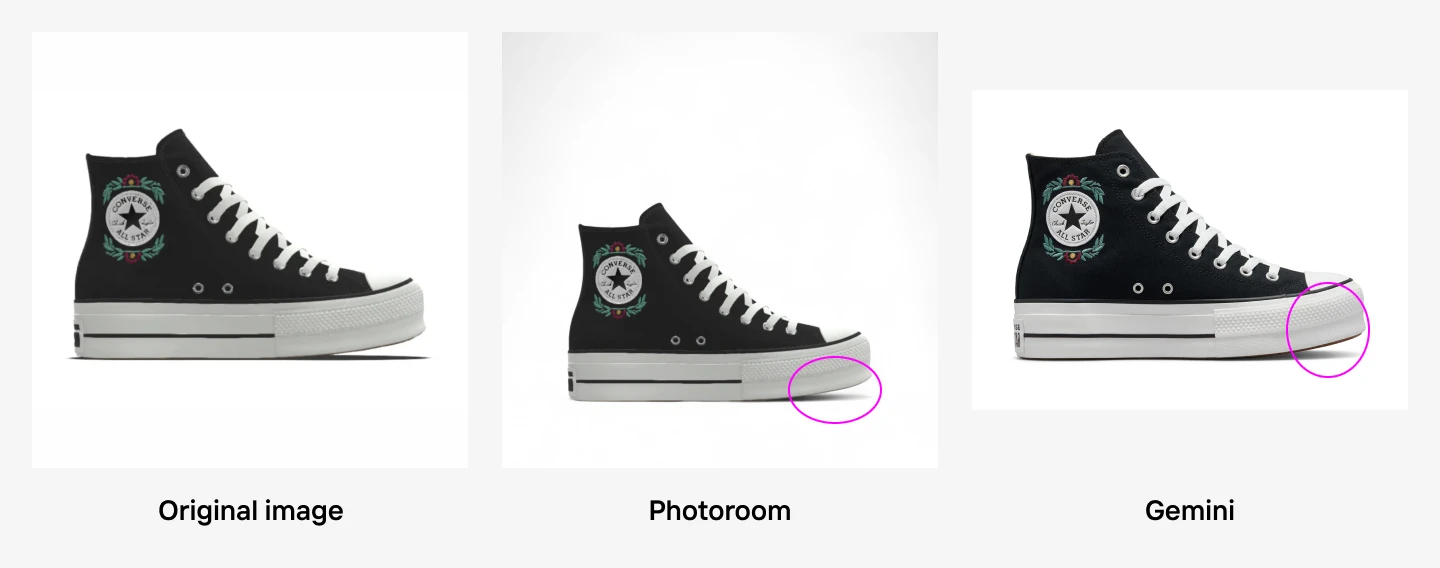 Same parameters, different results. Gemini Nano Banana produces a darker, more pronounced shadow that creates an artificial look that misrepresents how the product was photographed and would appear in real life. Photoroom delivers a soft, diffused shadow that meets ecommerce and marketplace standards.
Prompt used for Gemini: "Remove the background and place the object on a white background. Align the object vertically at the bottom. Add 15% of padding on all sides. Add a realistic soft shadow to the object."
Photoroom API parameters used:
Output size: 2000x2000
Shadow mode: ai.soft
Vertical alignment: bottom
Padding: 15%
Background color: white
Photoroom model: pr-ai-shadows-model-version: 2025-08-14
Why businesses choose Photoroom for product photography
Businesses choose Photoroom to automate product photography at scale, increase listing speed, and drive conversions with consistent images, without managing AI infrastructure.
Here's how e‑commerce teams use Photoroom:
1. Process large SKU volumes with automation
Managing thousands of SKUs manually creates editing bottlenecks that delay listings and slow time-to-market. Photoroom automates the entire product photography workflow at scale.
Tools that enable this:
Batch: Process multiple product images in minutes with consistent backgrounds, sizing, and enhancements applied automatically across entire uploads.
API: Integrate with existing codebase, DAM, PIM, and e‑commerce platforms, with dedicated technical support and compatible cloud environments.
Real impact: Luxury resale brand Valuence Japan improved its workflow after integrating the Photoroom API to process 24,000 photos monthly, saving $80,000 annually while reducing monthly editing time from 800 to 200 hours.
2. Improve product presentation at scale
Professional product presentation traditionally requires external costs like studio rentals, photographers, models, and photo editing software. Photoroom delivers professional results while saving on those resources, with production-ready exports up to 2K and 4K resolution.
Tools that enable this:
Remove Background: Remove and replace backgrounds while preserving product details.
Virtual Model: Create consistent model shots, with tools to adjust poses, scenes, and model type without the need for photoshoots or casting.
Product Staging: Add contextual backgrounds that match product categories at scale.
Product Beautifier: Automatically retouch and improve image quality.
Describe any change: Edit product photos using natural language.
Real impact: The British Red Cross used Photoroom's background removal, shadow, and lighting tools to optimize product listings for its charity shop, reducing time-to-sell from 72 to 48 hours while increasing average selling prices by 13%.
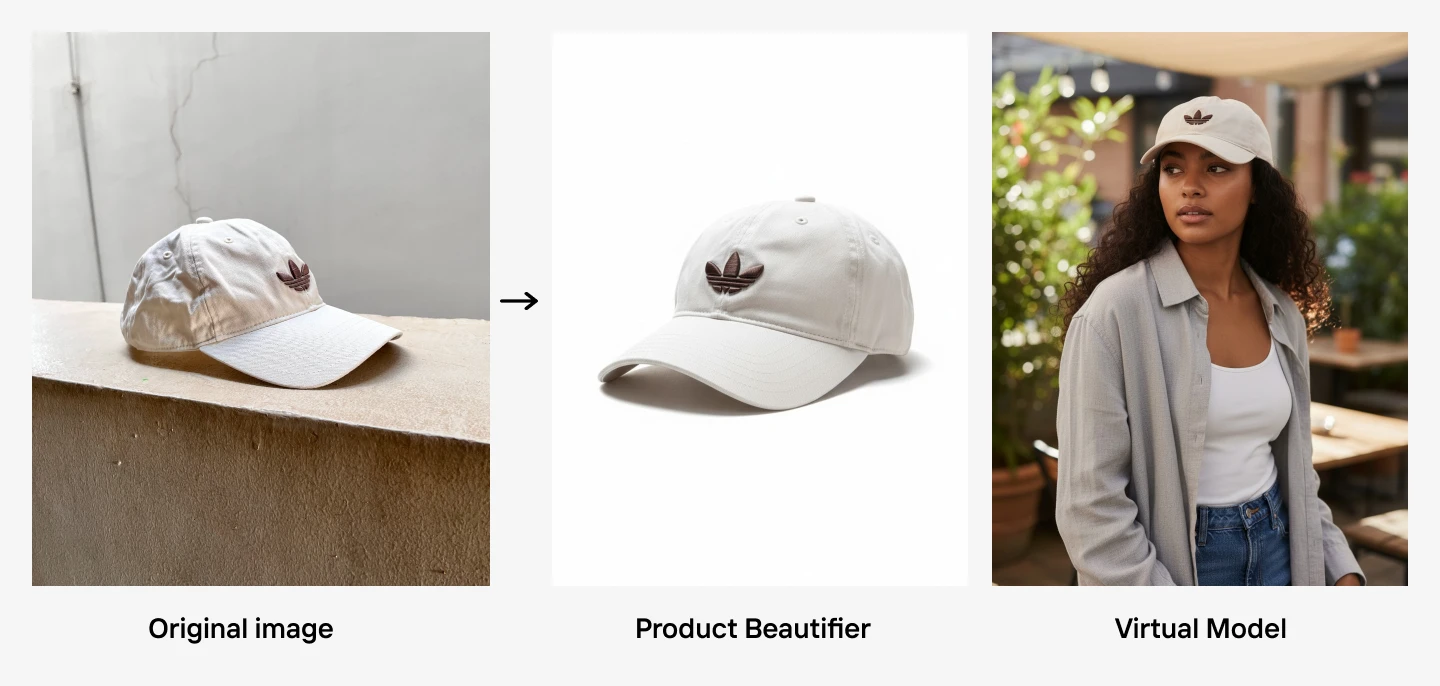
Quality of iPhone-shot baseball cap image improved using Photoroom’s Product Beautifier and Virtual Model tools.
3. Scale image consistency across platforms
When multiple teams, regions, or sellers independently create product images, image inconsistency can lead to marketplace rejections and failed compliance checks. Photoroom automates brand governance to ensure image consistency across all channels, while preserving product accuracy for simple and complex products.
Tools that enable this:
Brand Kit: Enforce image guidelines automatically across all product images.
Templates: Create repeatable, on-brand outputs for different product categories.
Marketplace compliance: Automatically format images for Amazon, Poshmark, and other marketplaces.
Analyze QA: Automate quality control by scoring images against brand standards and routing them to appropriate workflows.
Real impact: Global sporting goods retailer Decathlon integrated Photoroom to standardize product photos across 500 product categories during a catalog-wide refresh. After applying 150 packshot guidelines through Photoroom's workflow automation, 99% of products now pass quality tests against brand standards.
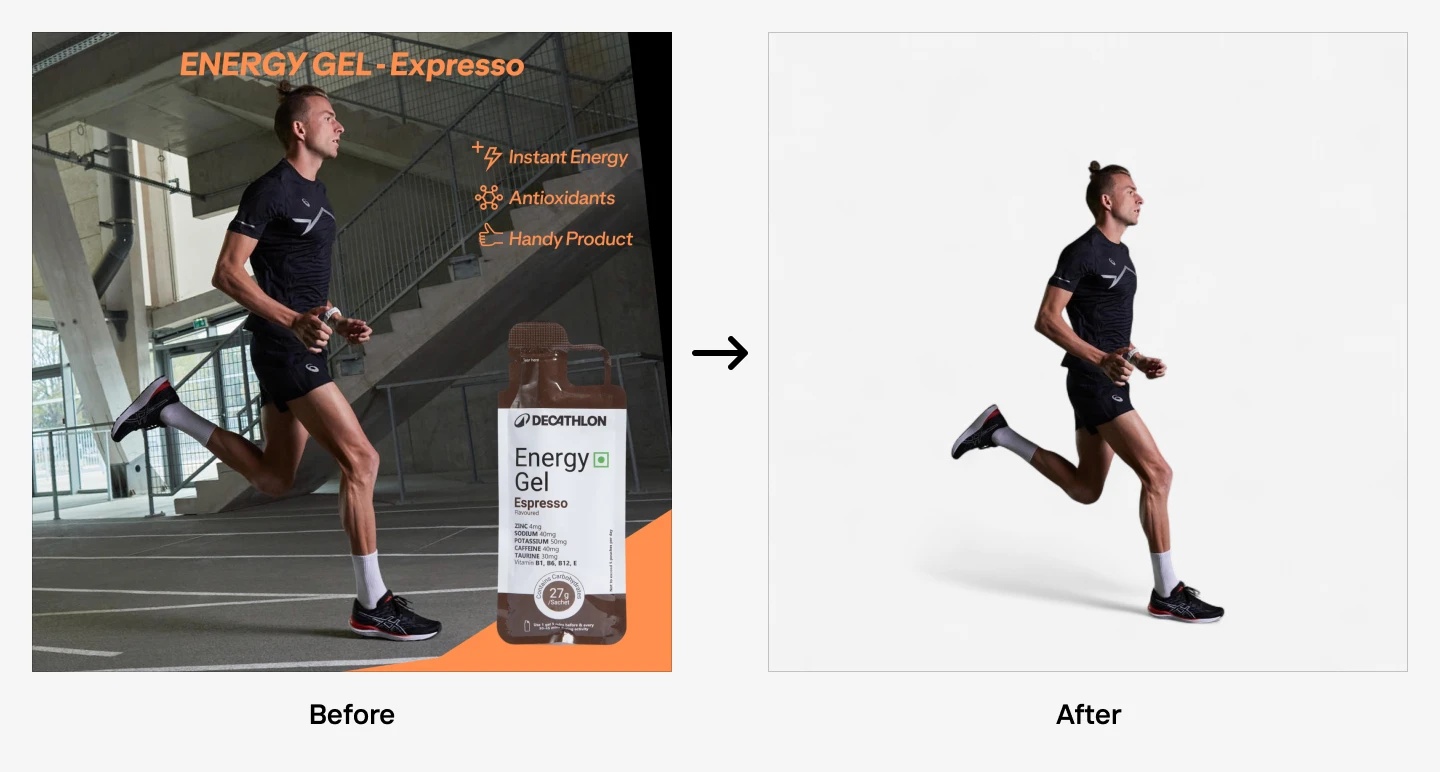 Photo with clean, brand compliant image background. Source: Decathlon.
4. Protect image assets and customer data
Enterprise teams need guarantees that product images remain secure and compliant. Photoroom provides SOC 2 certification, GDPR compliance, and zero long-term image storage for API customers.
Photoroom does not store API customer images long-term; third-party providers like Google Gemini retain outputs for up to 30 days, but never for training.
SOC 2 Type II certified for API security, availability, and privacy.
GDPR compliant, ensuring your data is handled with transparency, care, and respect for your rights.
PCI DSS is covered via Stripe for payment processing, so teams don't handle sensitive card data directly.
Enterprise contracts include indemnification provisions for AI-generated images.
Real impact: Global delivery platform Wolt processes tens of thousands of images across 27 countries using Photoroom's infrastructure, supporting 140,000 merchants and 36 million users with consistent picture quality. Photoroom delivers the global scalability and security standards that their enterprise operations depend on.
5. Avoid build and maintenance costs
Building an in-house image processing infrastructure diverts engineering resources from product innovation to ongoing maintenance. Photoroom handles the infrastructure so teams can focus on competitive differentiation.
Here’s what’s included:
10B+ images processed: Proven scale and reliability across millions of users.
99.9% uptime: Reliable processing at scale with consistent performance.
GPU infrastructure included: Photoroom provides the servers and computing power needed to process millions of images.
Dedicated technical support to guide teams through implementation.
Continuous model improvements: Automatic integration of better models without migration work.
Real impact: Fashion tech platform OpenWardrobe US. initially built an in-house solution for background removal but faced challenges with multi-category editing, performance, and high cost. Since switching to Photoroom, the company has reduced costs by 2x while processing over 100,000 images monthly with zero infrastructure overhead.
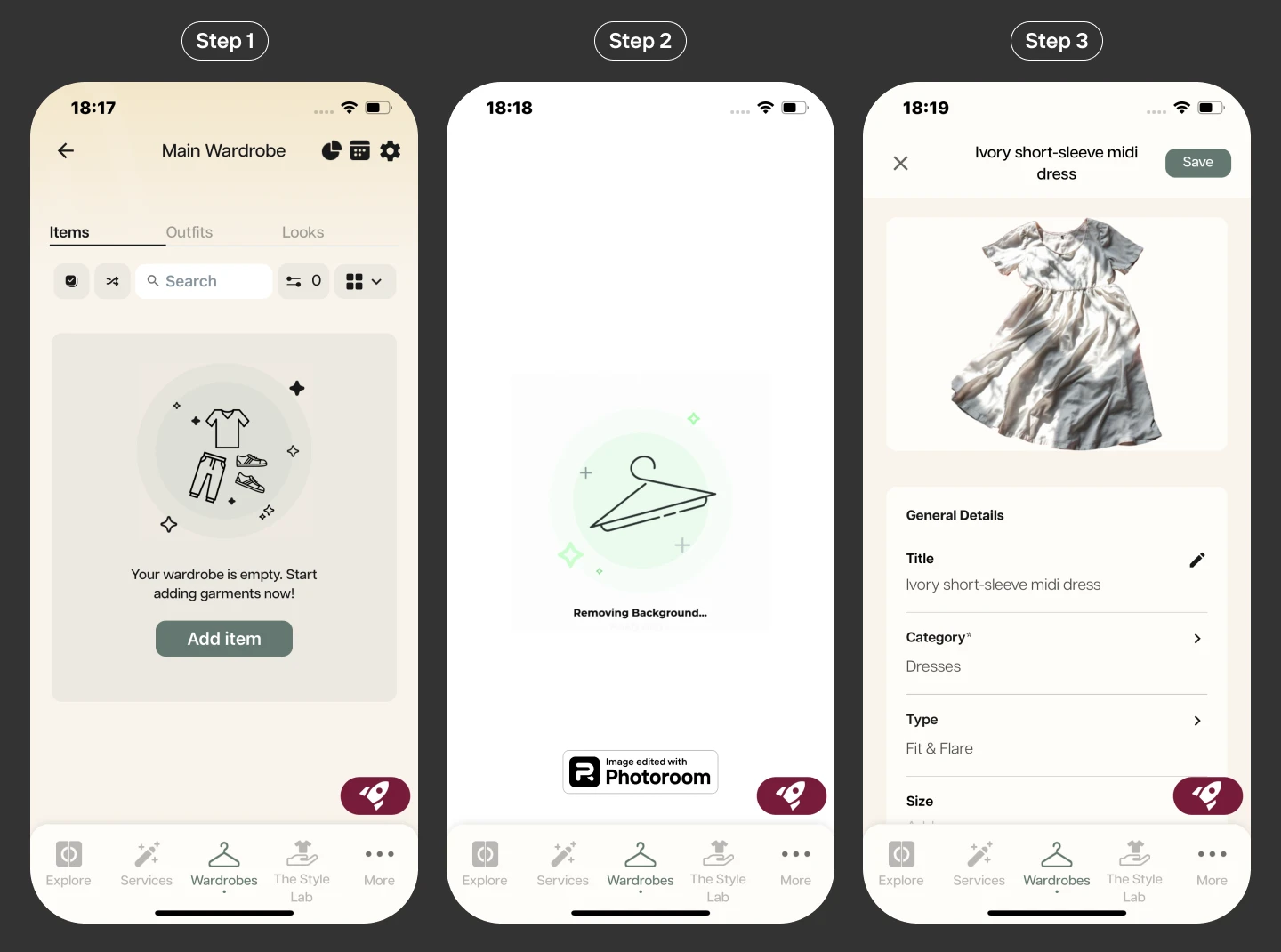 User workflow in OpenWardrobe iOS app showing Photoroom’s Remove Background tool at work
Commerce teams need reliable product photography that scales with business growth, not an AI infrastructure to manage their production.
Photoroom delivers complete product photography automation, combining specialized AI models and commerce-specific tools with enterprise security and continuous improvements. This combination allows commerce teams to scale image production efficiently, freeing up engineering resources to focus on competitive differentiation and growth.
Photoroom Gemini comparison: FAQs
1. What's the difference between Photoroom and Gemini for AI product photography?
Gemini is an AI model that performs general-purpose creative tasks but is not trained and doesn’t provide workflows for e‑commerce and marketplaces. Photoroom is a product photography platform specifically built for e‑commerce photo automation, brand control features, marketplace compliance tools, and consistent, realistic e‑commerce images at scale.
2. Can I use Gemini Nano Banana to create e‑commerce product photos?
Nano Banana 2 (also called Gemini 3.1 Flash Image) can generate and edit images with improved consistency, 4K resolution, and faster speeds than its predecessor. Google also offers batch processing and brand consistency features via Vertex AI. But Nano Banana 2 still lacks the e-commerce-specific capabilities teams need: automated marketplace compliance, product accuracy verification, and production-ready workflow integration that preserves product details without alteration.
3. Does Photoroom use Gemini Nano Banana for its AI product photos?
Photoroom integrates Google's Nano Banana model for select image editing and generation features as part of a model-agnostic architecture. The platform is built primarily on its own proprietary models, including its industry-leading background removal model, providing specialized e‑commerce functions like product preservation, lighting, segmentation, retouching, scene generation, and automated quality analysis.
4. Which is better for consistent, on-brand product photos: Photoroom or Gemini?
Photoroom delivers product image standardization through Brand Kit, templates, and automated compliance features for different marketplaces and regions. Gemini produces variable outputs, without strong focus on e‑commerce and marketplace brand governance or compliance features.
5. Are AI-generated product photos from Photoroom and Gemini realistic for marketplaces?
Photoroom is trained specifically on e‑commerce images, ensuring accurate and realistic product presentation without hallucination. Gemini is not trained for e‑commerce and marketplace use cases specifically, so it often hallucinates and produces variable outputs, altering the product in the image.
6. Can Gemini and Photoroom handle large-scale image automation for e‑commerce?
Photoroom processes millions of images monthly with 99.9% uptime through Batch in the web app and API integration. Gemini's enterprise models offer batch processing, but require custom development for marketplace compliance, ecommerce-specific quality controls, and workflow integration.
7. Which is better, Photoroom or Gemini?
For product photography at scale, Photoroom delivers workflow automation, brand consistency, realistic images, and marketplace compliance. Gemini is a powerful general model, but it requires some engineering work to produce consistent, realistic product images.

Etashe LintoI explore ways you can use AI technology to improve your product photos and create stellar visual content.